
By Joe Conrad
Being ready for a spike in fuel prices does not mean that you do not feel the pain when it arrives. Preparing for fuel price increases is similar to preparing for hurricanes in that the most prepared person can still suffer tragic losses. Just because you may have lost money because of the spike in fuel prices does not necessarily mean that you were unprepared, and it certainly does not mean that you are a bad businessman.
1. Understand Your Company’s Fuel Use
It is impossible to understand the impact of rising fuel prices on a company without knowing its fuel consumption. Keeping and analyzing records of fuel purchases and associated production levels is critical. For example, if Clarke Logging purchased 3,000 gallons of off-road diesel fuel in January for $9,300 and produced 5,000 tons of timber, then its fuel consumption rate was 0.6 gallons per ton (3,000 gallons / 5,000 tons) and the average fuel cost was $1.86/ton ($9,300/5,000 tons). With this information, the owner can estimate the impact of rising fuel prices on harvesting costs. If the fuel consumption rate is 0.6 gal/ton, if fuel prices rise by $0.50/gal, then harvesting costs will increase by $0.30/ton (0.6 gal/ton x $0.50/gal) and if fuel prices rise by $1/gal, then harvesting costs would increase by $0.60/ton (0.6 gal/ton x $1/gal).
The above is very simple and should not take very much time to complete. However, these estimates are imprecise. For example, if the company’s storage tanks were full at the beginning of the month and empty at the end of the month, then fuel consumption would have been underestimated. The above does not account for tract-to-tract variability in fuel consumption. These estimates could be improved by tracking fuel consumption and production over the long term rather than looking at only one month.
Collecting more detailed data would be helpful to better understand fuel consumption and adjust to price increases. Collecting fuel consumption data on individual machines is ideal. Data can be collected on late model equipment via telematics and may be available via app or website. Another approach would be to require operators to record the number of gallons added to their machine at each fill up, along with the date, hour meter reading, etc. This information could be used to identify fuel saving opportunities and evaluate how fuel consumption varies from tract to tract.
Oconee Logging has collected detailed information (Table 1). With this additional information, they can evaluate specific functions of their operation and identify opportunities to reduce fuel costs. Tracking this data over time can be especially valuable to detect fuel lost to leaks, equipment malfunctions, or theft.
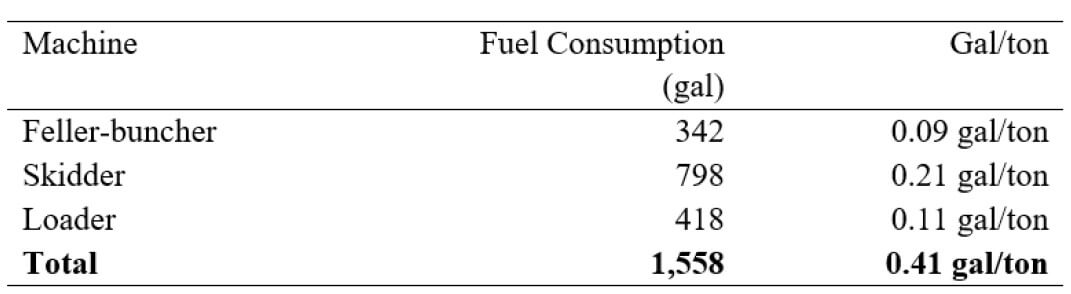
able 1: Oconee Logging fuel consumption by in-woods equipment during one month while harvesting 3,800 tons of timber.
2. Negotiate Fuel Cost Adjustments
The best time to negotiate fuel cost adjustments is before prices rise. Some companies have contracts that adjust automatically based on published fuel prices. The U.S. Energy Information Administration publishes weekly average diesel fuel prices, for example (Figure 1). These arrangements greatly reduce the risk faced by loggers. However, fuel prices go up and down. The contract reduces the logging rate when fuel prices fall.
Fuel cost adjustments, whether negotiated before prices rise or decided upon in response to price increases, should be based on data. A logging business that can clearly communicate the impact of fuel price increases with specific numbers will generally be more effective than those who simply pound the table about the pain inflicted by rising fuel prices. A logger that tells a procurement manager that a fuel price increase has raised costs by $0.50 per ton, and explains how that value was determined, has a much greater chance of negotiating a satisfactory agreement than someone who does not know this information. Of course, some purchasers are more amenable to these agreements than others.
3. Increase Cash Reserves
Fuel price increases expose a business to higher expenses in the short term and may result in losses if fuel cost adjustments are insufficient, delayed, or fail to materialize. Having sufficient cash available to weather short-term price increases can stave off insolvency and allow time to develop a strategy.
4. Reduce Fuel Usage
Obviously, there is a limit to this strategy. Diesel fuel is the lifeblood of a logging operation. However, improving fuel efficiency can meaningfully reduce costs.
Below are practical ideas shared by experienced logging professionals to help reduce fuel consumption:
- Reduce equipment idling. Idling wastes fuel. Modern emissions systems were not designed for extended idling, and modern engines no longer require lengthy warm-up periods. Excessive idling also consumes valuable warranty hours.
- Reduce skidding distance. Good harvest planning can shorten skidding distances, improving productivity while reducing fuel consumption.
- Maintain equipment. Fuel leaks, faulty injectors, and other mechanical issues waste fuel and reduce machine performance. Regular maintenance and timely repairs improve efficiency and extend equipment life.
- Match equipment to site conditions. Operating machines within their intended design specifications improves efficiency and reduces fuel use per ton. For example, a large feller-buncher may be underutilized on a first thinning, while larger skidders can often reduce fuel consumption per ton.
- Maximize truck payload. Trucks loaded to the maximum legal limit consume less fuel per ton than underloaded trucks.
- Increase percent-loaded miles. Fewer than half of all log truck miles are loaded. Whenever backhaul opportunities exist, they reduce fuel consumption per ton of wood delivered.
- Coach drivers. Improved driving habits can increase fuel efficiency by an estimated 5–15%. Even improving fuel economy by 0.5–1 mpg can produce meaningful savings over time.
Conclusion
Fuel price increases are an unavoidable reality for logging business owners (Figure 1). Preparing for them should be part of every business plan, just as preparations are made for severe weather or other unexpected events. Preparation cannot eliminate every challenge, but it can reduce the financial impact and improve a company's ability to respond effectively.
Useful Formulas

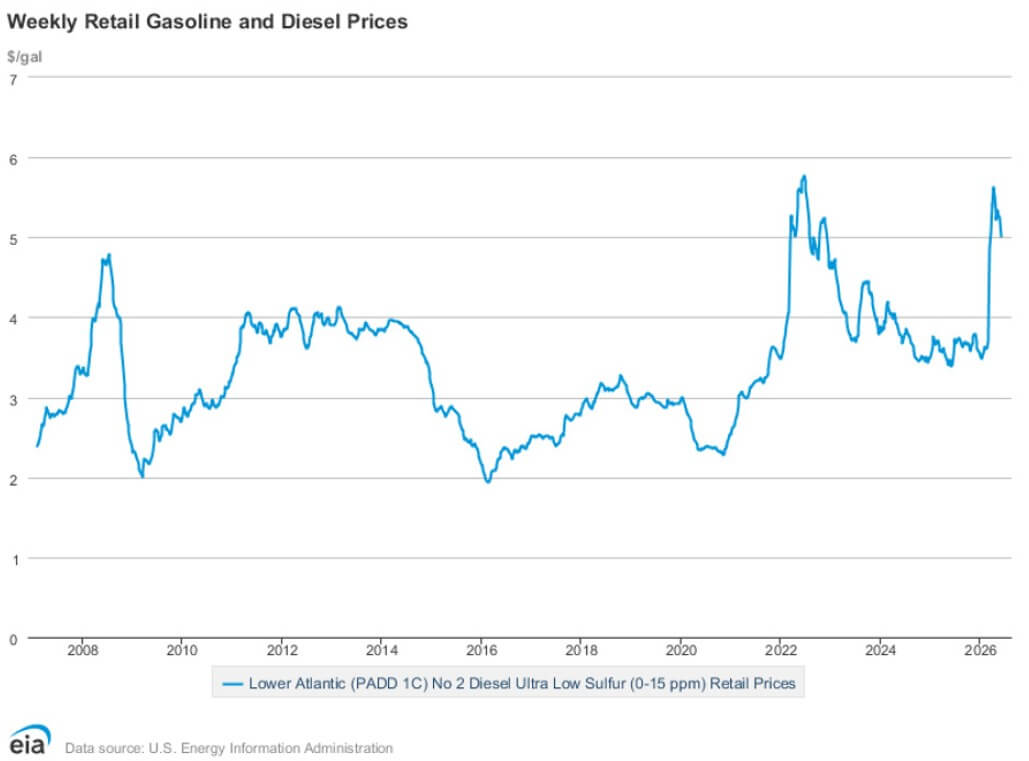
Figure 1: Weekly on-highway diesel prices in the Lower Atlantic region (includes NC and neighboring states) from 1994–2026.
Reference
Energy Information Administration. 2026. Weekly retail gasoline and diesel prices. Accessed June 4, 2026. https://www.eia.gov/dnav/pet/pet_pri_gnd_dcus_r1z_w.htm.
📖 Read the Latest Issue of the Carolina Logger →