
January 27, 2026
What You’re Seeing Isn’t Destruction. It’s Forestry.
By Jonzi Guill & Jean-Paul Damé
Many of us have seen a patch of woods suddenly cleared, leaving stumps, mud, and piles of brush. For most people, this sight is unsettling.
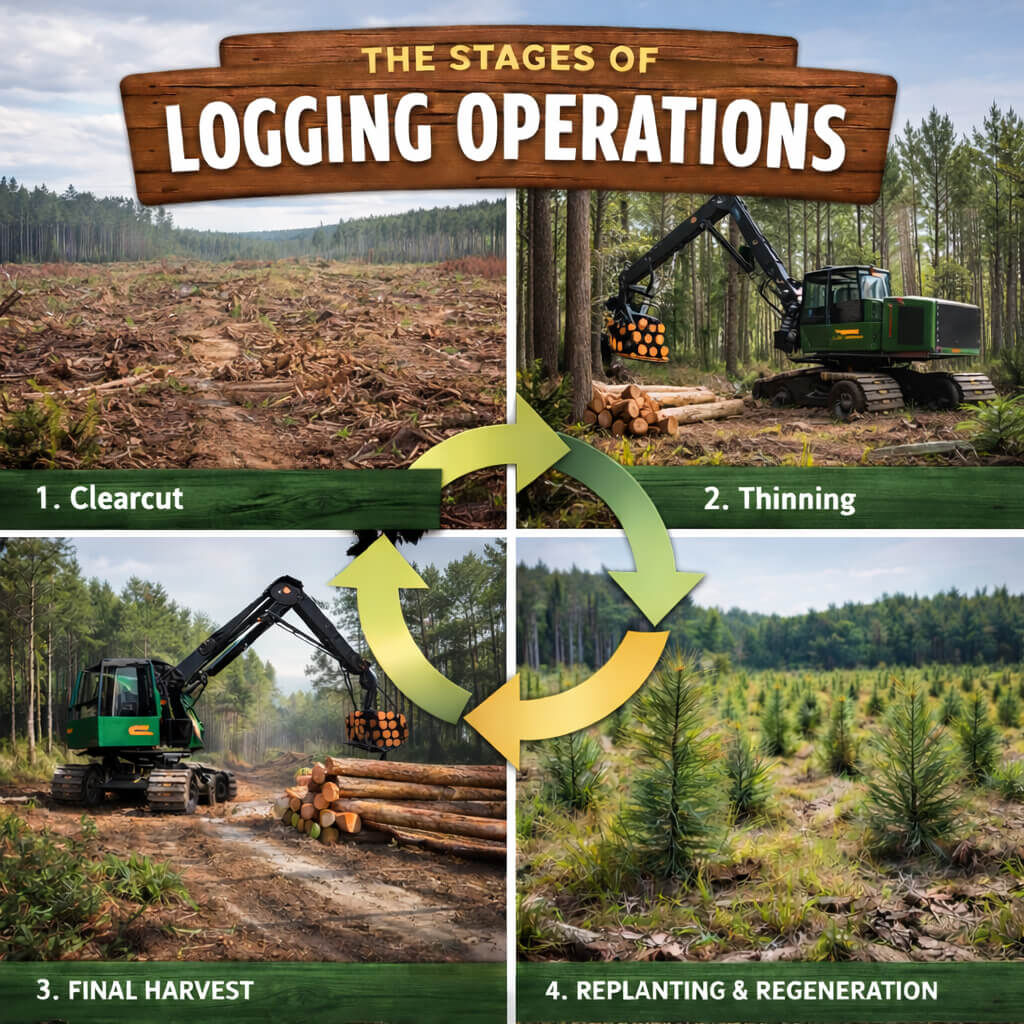
At first glance, it may appear the forest has been destroyed. In reality, this is one stage in a decades-long cycle that sustains our forests, land productivity, and rural economies. This process is called forestry. I invite you to learn what truly happens on this land, as it deserves more than a passing look.
When a landowner decides to grow pine, it is a significant investment, often with long-term results they may not see themselves. With support from local, state, and federal foresters, and research from institutions such as NC State University, genetically improved seedlings are carefully selected, matched to soil and slope, and purposefully planted. Modern forestry is a high-tech operation.
These are managed stands, organized row by row with the same intention as planting a cornfield. However, the harvest cycle may last 25 to 30 years or longer, rather than a single season.
Mixed stands of wild woods, pine, and hardwood are sometimes clearcut as well. Some landowners, however, allow these stands to grow naturally and harvest them much later. For now, the focus is on pine crops.
As young trees grow, competition for light, nutrients, and water increases. The first thinning occurs between years five and ten, when loggers selectively remove weaker trees. This allows stronger trees to thrive, reduces disease risk, and enhances the long-term value of the stand.
A by-product of thinning is biomass, often processed into wood pellets. These pellets are sold to companies for use as renewable fuel, replacing coal or natural gas in electricity generation worldwide. Over 6 million metric tons are produced annually across the Southeast. Importantly, none of the thinned wood is wasted; it supports environmental sustainability by reducing reliance on fossil fuels.
This phase is often overlooked but is essential for forest health. Stands are thinned several times before the final harvest, which may occur around year 30 if the goal is to produce telephone poles.
When the stand matures, it is harvested. This clearcutting is conducted responsibly, not recklessly.
Before harvesting begins, the operation is carefully planned. Stream buffers are marked and protected, access roads are designed to prevent erosion, and wetlands and sensitive areas, including those with threatened or endangered species, are identified. Crews follow Best Management Practices, which are industry standards that protect water, soil, and wildlife. Many operations also adhere to the Sustainable Forestry Initiative, a national certification program that requires long-term planning, regeneration, and environmental stewardship.
Water quality is protected by maintaining streamside buffers that must remain undisturbed in accordance with Best Management Practices. These 50-foot buffers shade the water, prevent soil from entering streams, and help maintain water temperature, which is vital for wildlife. Stabilized roads and erosion controls are mandatory and strictly enforced in all modern operations.
Clearcutting, particularly in pine systems, is necessary to restart the growth cycle. Pines require full sunlight to regenerate, so partial cuts are ineffective. The open space created is an opportunity for the next forest, which provides essential products for daily life.
Replanting may begin within weeks of harvest, or the forest may be allowed to naturally reseed. In both cases, the process is carefully managed. Often, the next generation of a family oversees the land, continuing the cycle even if the original landowner does not see the new crop mature. The land is renewed, the forest refreshed, and the habitat restored.
While logging initially displaces wildlife, small animals such as rabbits, quail, and songbirds thrive in the dense ground cover left behind. This, in turn, attracts predators like hawks, foxes, and bobcats. The edge between forest and open space becomes one of the most active areas in the ecosystem, and larger wildlife eventually return.
In North Carolina, many mills and logging companies require harvested wood to come from land managed under SFI standards. A certified forester oversees each tract, ensuring Best Management Practices are followed, marking zones and trees to be retained, and verifying that three to five trees are planted for every one harvested.
There is more forested land in the U.S. today than at the turn of the 19th century. Over the past 120 years, many former farms and croplands have been converted to forestry operations. However, property taxes remain a significant challenge. If the land cannot generate enough income to cover taxes, the landowner may lose it, resulting in the loss of a family legacy and farm, a generational setback.
Consider the wood in your floors, cabinets, and framing, the paper you use, cardboard boxes, garden mulch, and even components in diapers, paint, and fuel. All of these products originate from managed forestland, often pine, and a system designed for continuous renewal.
Most lumber used for fences or decks is sourced locally. The forest industry prioritizes local wood to prevent the spread of disease and invasive insects that can harm ecosystems. Those who work the land are committed to maintaining its health and beauty, focusing on sustainability for future generations rather than immediate gain.
Landowners, loggers, and foresters recognize the importance of old-growth and virgin forests. When such areas are found, they are reported, flagged, and information is shared with state or federal professionals. Few virgin forests remain in the U.S., as most were harvested centuries ago, but those that persist are now protected and valued.
Without incentives for landowners to grow trees, many forests would disappear, not due to logging, but because they would be permanently cleared, developed, or converted to other uses.
When forestry pays, forests stay.
Seeing a clearcut can be unsettling. After more than twenty-eight years in the industry, I have witnessed these sites transform over time. Saplings grow into mature forests, and families, often third or fourth-generation landowners, take pride in improving the land for the future.
Clearcutting is not destruction; it is part of the working forest cycle. Understanding this process is essential to effective forest conservation.
If you are interested in learning more, visit forests.org to discover what happens during a harvest and what follows.
If you’d like to stay informed, sign up for the Carolina Loggers Association’s free quarterly newsletter at ncloggers.com, or become a member today and support the loggers, landowners, and foresters who are helping manage North Carolina’s forests for future generations.